


Hello fellow designers, creatives, digital professionals, and Eidos Design members!
Mykola here, back with November’s most fascinating news from the intersection of design and technology.
This month was about all about the layers of infrastructure that make AI useful in design workflows. Every major announcement, from Figma’s design system overhaul to Webflow’s production-ready code generation to Sketch’s defiant native bet, was part of a single, cohesive shift: design tools are becoming operating systems.
November revealed the architecture of the next era. If you understand it, you can lead it. If you don’t, you’ll be managed by it.

Fresh Squeeze: The Month Design Infrastructure Transformed
Figma’s Schema 2025: Design Systems Become Translation Layers for AI
On November 12, Figma opened a strategic hub in Bengaluru, signaling a commitment to India’s growing product community. India is now Figma’s second-largest active user market, with over 40% of the top BSE 100 companies already customers. The office opening marks a recognition that design infrastructure must be truly global.
But the real November story crystallized when Schema 2025’s announcements, made in October, began rolling out in earnest across design teams.
Extended Collections are now rolling out to Enterprise full seats, solving the multi-brand problem that’s plagued large design systems for years. Design system authors can publish a core system that designers extend with their own themes, inheriting updates automatically. Parent updates sync to children. No more manual reconciliation across 47 different brand variants.
And here’s where AI enters: Check Designs, Figma’s AI-powered linter, is now available in early access for Organization and Enterprise full seat plans. It automatically suggests which design tokens and variables from your system should be applied to your designs. You’re not just managing components anymore, you’re training AI to understand your design intent.
Figma MCP Server is now generally available to all users. This is the technical bridge: your design system is now readable by AI coding agents directly from Claude, Cursor, or any MCP-compatible tool. Your Figma link becomes the context for code generation. Your variables become data that AI respects.
The performance rewrite underneath? Massive. Figma refactored the entire architecture of design systems. Variables and mode switching are now 30-60% faster. Heavy state swaps dropped from 3,500ms to 350ms. Files with thousands of component instances feel responsive.
Design systems stopped being static styleguides. They became the interface between human intent and AI execution.
Webflow’s November Rollout: AI-Ready Web Platform at Scale
At Webflow Conf (September 16, 2025), the company announced a complete reimagining of its platform. November is when that vision began rolling out to users.
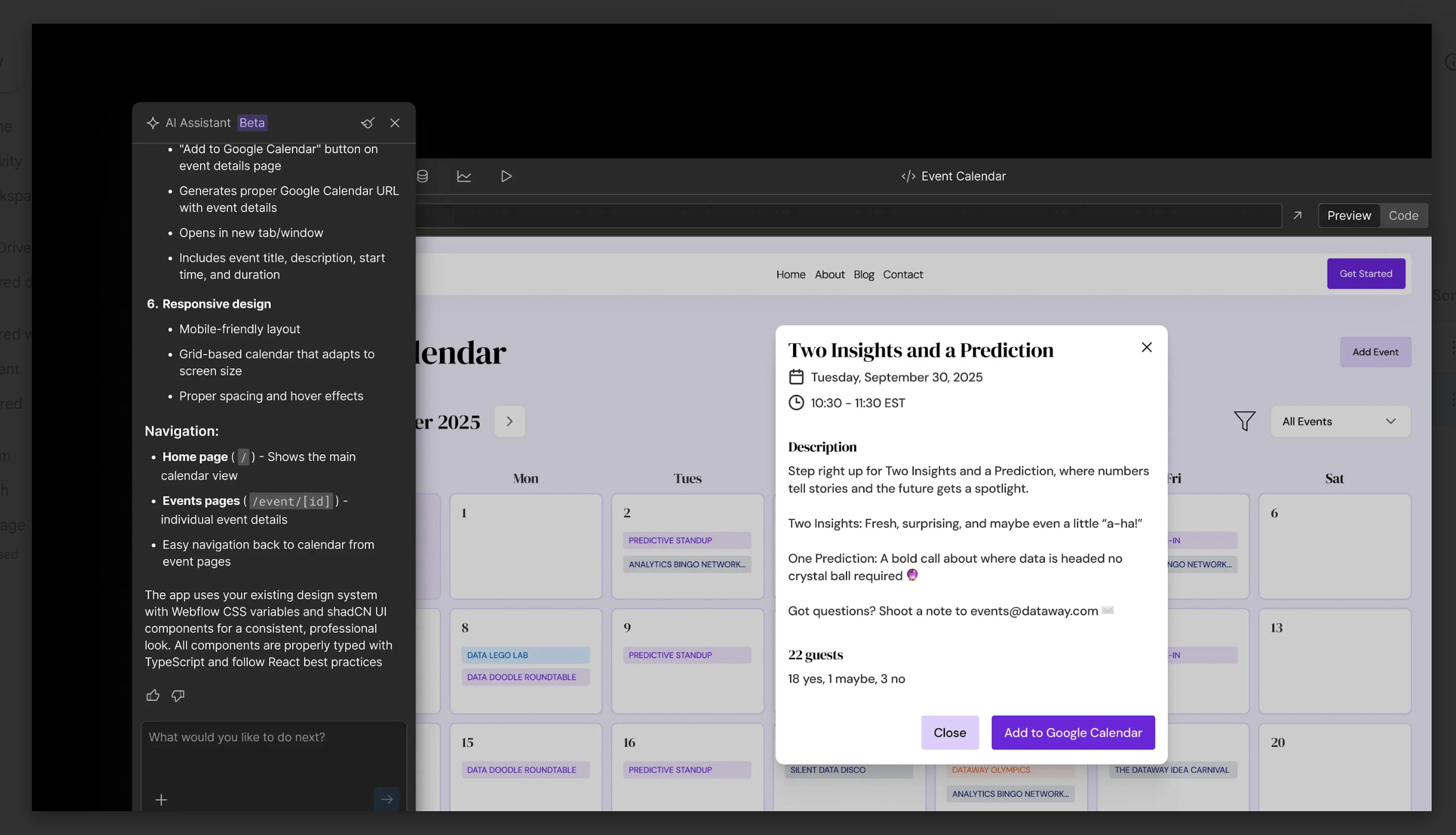
The reimagined AI Assistant is now available, functioning like an intelligent team member. It understands your site’s structure, styles, and CMS content. Ask it to refactor a section to match your class naming convention, it sees your patterns and applies them. Ask it to turn a section into a reusable component—it does, preserving all cascade logic.
This isn’t autocomplete. It’s context-aware design work. The AI reads your site like a human would, but at scale.
Webflow’s AI Code Generation (App Gen) is shipping in November, allowing designers to describe features in plain language (“Create a user dashboard with real-time data updates”), and Webflow generates production-ready React components that deploy to Webflow Cloud immediately. No developer translation layer. No “developer will rebuild this.” Ship directly—built on Astro, with design system compliance baked in.
The Next-Gen Webflow CMS, announced in September, is rolling out in November with architectural changes that quietly matter: Enterprise sites can now scale to over one million CMS items, with double the fields per collection, double the reference fields, and 10x more nesting levels. Content Delivery APIs are now available to all customers, enabling multi-channel deployment (web, apps, email, AI agents).
Web builders stopped being drag-and-drop toys. They became production infrastructure that designers control.
Figma’s Developer Platform: New Standards for AI-Ready Apps
On November 17, Figma tightened standards for apps on its platform. New OAuth requirements. Stricter rate limits. Mandatory re-publishing deadlines.
Figma is explicitly saying: if your app wants to access Figma context and power AI workflows, you need to meet standards. Period.
The message to builders: Figma is no longer a tool for solo designers. It’s enterprise infrastructure for product teams. If you’re building integrations, you’re building in an audited, structured environment.
Design tools are becoming platforms. Platforms need standards.
Canva’s October Move, November Reality: Design Operations at Scale
On October 30, Canva announced two seismic moves. By November, they were both undeniable.
First: Canva made Affinity completely free. Not a trial, actually free, permanently.
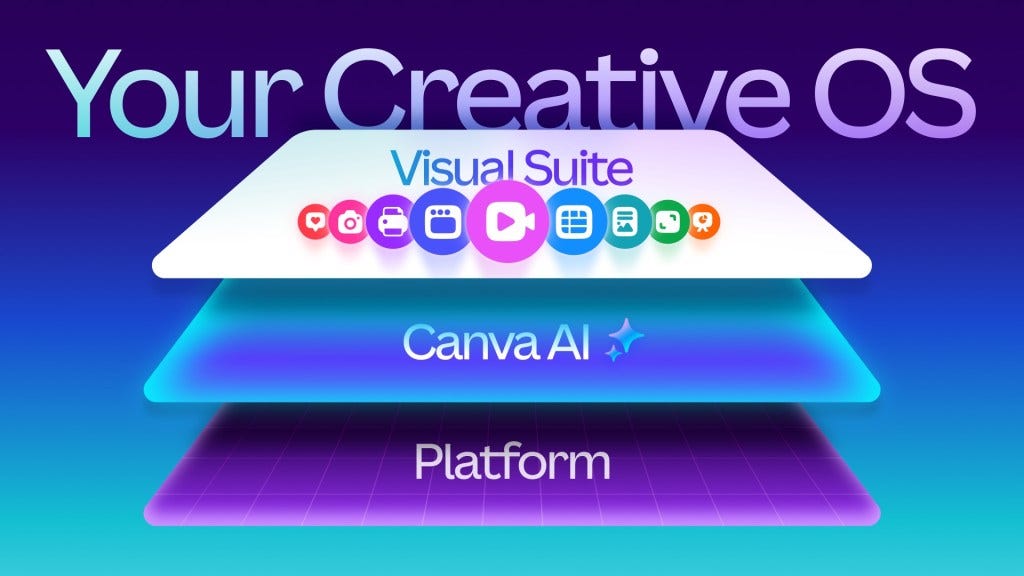
Second: Canva launched its own foundational design model—trained on Canva’s library of design elements, it generates designs with editable layers and objects, not flat images. A Canva AI prompt creates a design you can actually modify in Affinity or Canva Pro. Not just a JPG you’re stuck with.
This month, Canva integrated AI across the entire interface: in the design tab, the elements tab, in comments (mention @Canva to get suggestions while collaborating). The 3D object generation feature shipped, along with the ability to copy art styles from existing designs.
Canva also shipped forms (competing with Google Forms) and email design (competing with Mailchimp), expanding beyond “design creation” into “design operations.”
Canva stopped being a tool for making designs. It became a platform for orchestrating design operations across products, emails, forms, and spreadsheets.
Sketch Stays Native While Everything Else Goes Web
On November 18-19, Sketch released Copenhagen (2025.3), their largest redesign since 2020’s Big Sur update. This is what staying native means in an AI world.
Performance: documents open 5x faster. Image background removal runs on-device using Apple’s ML. Contextual toolbars adapt to your current task. The UI speaks macOS Tahoe’s “Liquid Glass” aesthetic natively.
While Figma, Webflow, and Canva race toward web ubiquity and AI APIs, Sketch is making a calculated bet: some designers still want tools that feel like home, process data locally, and never ask for internet connectivity.
The risk? Shrinking market. The opportunity? Profoundly loyal users who value privacy and craft over collaboration sprawl.
Handpicked Highlights
👉 5 Shifts Redefining Design Systems in the AI Era — Figma Blog
Figma’s definitive November 18, 2025, piece on how design systems evolve from static libraries into “living frameworks” that encode craft, taste, and intent—enabling AI to preserve quality at scale. Key insight: Design systems become active carriers of craft, not just consistency checks.Essential for anyone rethinking design ops or governance.
👉 The Rosetta Stone of Design Engineering — Yann-Edern Gillet (Written Essay)
Published November 19-20, 2025. The written companion to his Design Engineering Night talk—deeper exploration of how design engineers function as translators between design intent and technical execution. Highly recommended for design engineers wanting to articulate their role and value systematically.
👉 Real-World AI for Everyone — Coursera Specialization
A hands-on, non-technical introduction to AI fundamentals designed for creatives, PMs, and product thinkers. Covers prompt engineering, AI workflows, and practical applications—directly relevant to November’s theme of AI becoming infrastructure.
👉 Strategy and Influence for Product Designers — Dan Winer Course
Dan Winer’s ongoing course teaches designers how to shift from execution-focused roles to strategic partners. Focus: product discovery, stakeholder communication, and delivering insights, not just designs. Active through November 2025.
What This Month Actually Meant
November wasn’t about individual features. It was about the layers of infrastructure that make AI useful in design workflows.
1. Design systems as bridges: Extended Collections, Check Designs, Figma MCP: all making design systems legible to AI agents. Your variables aren’t just pretty tokens anymore. They’re data that AI understands.
2. Code generation as commodity: Webflow, Canva, Figma Make, and Build0 all made it trivially easy to turn prompts into production code. The skill isn’t coding anymore. It’s knowing what to build and why.
3. AI context as workflow: Webflow’s assistant reading your site structure. Figma’s linter understands your tokens. Canva’s model respects layers and objects. AI stopped being a generic tool. It became contextual to your work.
4. Platform consolidation: Canva adds forms and email. Webflow adds code generation and full-stack CMS. Figma ships MCP and design system scaling. Each tool is no longer “one thing.” Each is becoming the digital operations layer for a specific type of work.
What Designers Should Notice
The market for generic design skills continues to compress. Knowing Figma or Framer or Webflow? That’s table stakes now, and it’s getting automated away.
What actually matters:
Understanding systems thinking: Can you architect design systems that AI can understand and leverage? Can you think in tokens and variables, not just pixels?
Knowing what’s worth building: AI can generate 1,000 layout options in seconds. Humans decide which one solves the real problem.
Bridging contexts: The designers who win move fluently between Figma, code, data models, and stakeholder intent. Not “I’m a designer.” More like “I architect digital experiences across multiple contexts.”
Staying opinionated: Sketch’s bet on native. Framer’s bet on performance. Your bet on what matters is the differentiator.
What Happens Next
December will be intense. Figma slots hit beta (component patterns that finally feel modern). Webflow’s next-gen CMS fully rolls out. Expect announcements around design-to-AI pipelines, more design system interoperability, and probably a major acquisition or integration we haven’t seen yet.
The uncomfortable truth: if you’re still thinking about November 2025 as “design software + AI features,” you’re already behind. The real story is “design infrastructure is becoming AI infrastructure.” Tools are becoming platforms. Platforms are becoming operating systems for product teams.
The designers who thrive aren’t the ones fighting this. They’re the ones architecting through it.
I’m watching, learning, and rebuilding my own mental models alongside you.
If this edition sparked something for you, share it with someone who needs to read it. And subscribe if you haven’t already. November’s going to be wild.
Sincerely,
Mykola Korzh